How to Build a Fragrance Pyramid That Actually Reflects Your Formula
Why top/heart/base feels guessy and inconsistent—and how formula deep dives plus pyramid visualization make it a real learning tool.
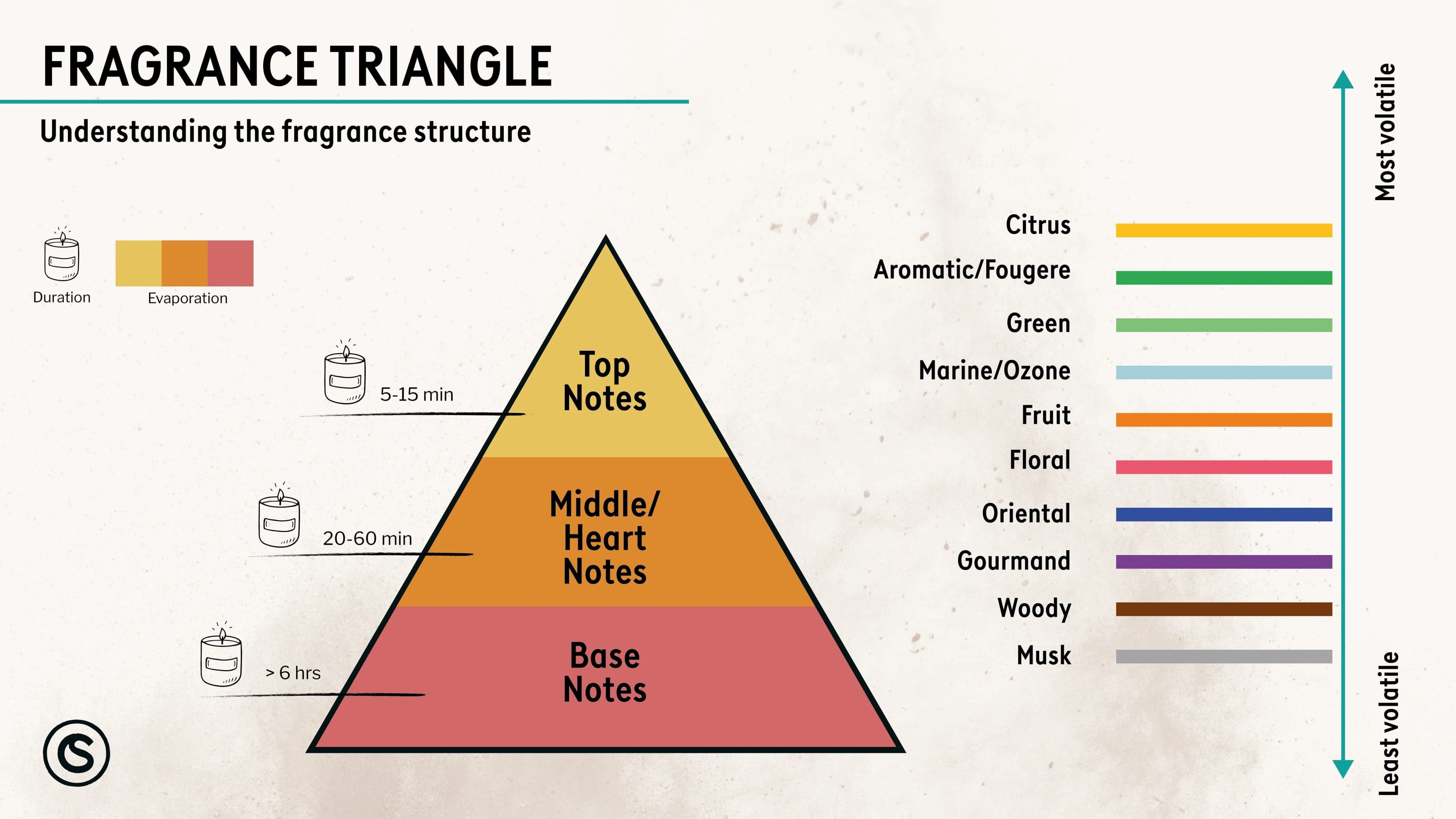
You've tagged ingredients as top, heart, or base—but when you look at your formula, does the pyramid actually match? Sometimes a "base" material is used at 2% and a "top" at 15%, so the balance feels off. Or you're not sure how to read your own formula: where's the weight, where's the lift? Top/heart/base can feel guessy and inconsistent unless it's tied to real numbers.
Top/heart/base felt guessy—I never knew if my pyramid actually reflected what was in the formula.
— The pain every perfumer hits
Building a fragrance pyramid that actually reflects your formula means using the note type of each ingredient—and the percentages—to see the real structure. This guide explains how to think about the pyramid, how to make it consistent, and how formula deep dives plus pyramid visualization turn it into a learning tool.
Why top/heart/base feels guessy
When you tag ingredients as T, H, or B but never look at the totals, you're guessing. A formula with 50% "base" by ingredient count might have 5% base by weight if those materials are used in trace amounts. The pyramid should reflect impact—and that means percentages (or grams) per layer, not just how many ingredients sit in each tier.
Count vs. weight: a concrete example
Formula with 10 ingredients: 5 base notes (each at 1%), 3 heart notes (each at 5%), 2 top notes (each at 20%). By count: 50% base, 30% heart, 20% top. By weight: 5% base, 15% heart, 40% top (plus 40% solvent). The weight-based view shows what actually dominates the smell—a top-heavy, likely fleeting fragrance.
When every formula is different—one spreadsheet has note types, another doesn't—you can't compare. A good system shows note type per ingredient and can sum by layer: total % in top, heart, base. Then the pyramid is consistent and readable.
What a pyramid that reflects your formula looks like
Each ingredient has a note type (top, heart, base). The formula shows each ingredient's percentage—and ideally the total percentage per layer. You see at a glance: how much of the formula is top notes, how much heart, how much base. The pyramid isn't a metaphor—it's a summary of your formula's structure. That's how you learn: tweak a base, see the base total move; add a top, see the top total rise.
Formula deep dives and pyramid as a learning tool
A formula deep dive is when you open a formula and see everything: ingredients, percentages, note types, totals per layer, maybe cost or IFRA. When the pyramid is visible—totals by top/heart/base—you can read your formula like a map. "This formula is base-heavy." "I need more top for lift." That's the learning tool: not guesswork, but structure you can see and adjust.
Pyramid visualization—whether as a simple breakdown (X% top, Y% heart, Z% base) or a small chart—makes the structure obvious. Over time you develop a feel for balance: how much base is too much, how little top leaves a formula flat. The pyramid stops being guessy and becomes a reflection of what's actually in the bottle.
How Perfume Workbench supports pyramid and deep dives
Perfume Workbench gives you note type (T, H, B) per ingredient and shows it in every formula. You can see which ingredients are top, heart, or base—and when the app shows totals per layer (or lets you scan the formula with note types visible), the pyramid is right there. Formula deep dives—open a formula, see ingredients, percentages, note types, and structure—turn the pyramid into a real learning tool: consistent, readable, and tied to your actual numbers.
Try it
Open a formula in Perfume Workbench and look at the note types (T, H, B) next to each ingredient. See how much of the formula sits in each layer. Tweak one ingredient and watch the balance shift—that's the pyramid reflecting your formula, and that's how you learn to build it.