IFRA Basics for Hobbyists: What It Is, What It Isn't, and Why It Matters
Cut through the confusion around IFRA standards. Learn what these safety guidelines actually mean for DIY perfumers, when they apply, and how to use them as helpful guardrails—not roadblocks.
If you've spent any time in perfumery forums or Facebook groups, you've probably encountered IFRA. And if you're like most hobbyists, your first reaction was somewhere between confusion and mild panic.
Wait, my favorite oakmoss is restricted? Coumarin has a limit? Am I going to hurt someone with my perfumes?
— Every hobbyist's first encounter with IFRA
Take a breath. IFRA isn't as scary as it seems—but it is worth understanding. This guide cuts through the confusion, explains what IFRA actually is (and isn't), and shows you how to use these standards as helpful guardrails while you learn the craft.
What is IFRA, really?
IFRA stands for the International Fragrance Association. It's a global trade organization that represents the fragrance industry—the big houses, suppliers, and manufacturers who create scents for commercial products.
IFRA publishes Standards: a set of guidelines that specify maximum safe usage levels for fragrance ingredients. These standards are based on scientific research, primarily from RIFM (the Research Institute for Fragrance Materials), which conducts safety assessments on thousands of aromachemicals and naturals.
The official source
You can browse IFRA Standards directly at ifrafragrance.org. The IFRA library contains detailed information about restricted ingredients, including the scientific basis for each restriction.
What IFRA Standards actually say
For each restricted ingredient, IFRA specifies:
- Maximum usage levels for different product categories
- Whether the ingredient is prohibited entirely in certain applications
- Any special requirements (purity specifications, documentation)
- The scientific rationale behind the restriction
The restrictions are based on potential risks: skin sensitization (allergic reactions), phototoxicity (reactions triggered by sunlight), or other safety concerns identified through testing.
What IFRA is NOT
Here's where hobbyists often get confused—or unnecessarily worried. Let's clear up some common misconceptions:
IFRA is not law
IFRA Standards are industry self-regulation, not government regulations. In most countries, there's no legal requirement for hobbyists making perfumes for personal use to follow IFRA guidelines. You won't go to jail for using 1% oakmoss absolute in a perfume you wear yourself.
But there's a caveat
If you sell your perfumes or give them as gifts, the situation changes. You become responsible for product safety, and IFRA compliance becomes important—both for protecting others and protecting yourself from liability.
IFRA is not about banning creativity
Some perfumers view IFRA as the enemy of artistry—bureaucrats ruining classic formulas. But the restrictions exist because some ingredients can cause real harm at high concentrations. Oakmoss isn't restricted because someone doesn't like chypres; it's restricted because a significant percentage of people develop skin sensitization to certain compounds in it.
You can still use restricted ingredients. You just need to use them at safe levels—which often still allows for meaningful contribution to a fragrance.
IFRA is not a complete safety guarantee
Following IFRA doesn't make your perfume automatically "safe" for everyone. Some people have sensitivities to ingredients that aren't restricted. IFRA covers known, documented risks—it can't predict individual reactions.
Why should hobbyists care?
If IFRA isn't legally required for personal use, why bother learning it? Several good reasons:
1. You might want to sell someday
Many hobbyists eventually start selling their creations—at craft fairs, online, or to friends and family. If you've been formulating without any awareness of IFRA, you'll have to reformulate everything. Better to build good habits from the start.
2. You might give perfumes as gifts
That birthday perfume for your friend? You're now responsible for its safety. If your friend develops a rash because you used 5% cinnamon bark oil (IFRA limit for Category 4 fine fragrance: 0.07%), that's on you.
3. Understanding limits makes you a better perfumer
Knowing that certain ingredients have restrictions forces you to be more creative. How do you get that oakmoss character within the limit? What alternatives exist? Working within constraints often leads to more interesting compositions.
4. It's useful information about ingredient character
An ingredient with a very low IFRA limit is telling you something: it's powerful, potentially sensitizing, or needs careful handling. That's useful knowledge regardless of whether you follow the limits strictly.
Think of IFRA limits as a map of where the strong currents are. You can choose to swim there anyway—but you should know what you're getting into.
Understanding IFRA categories
IFRA doesn't set one universal limit per ingredient. Instead, limits vary by product category—because exposure levels differ dramatically between, say, a fine fragrance (applied to pulse points) and a bar soap (rinsed off immediately).
The 11 IFRA categories
IFRA defines 11 product categories, each with its own set of limits:
- Products applied to lips (lip balm, lipstick) — strictest limits
- Products applied to axillae (deodorants)
- Products applied to face/body using fingertips
- Fine fragrance (perfume, EDT, EDP) — what most hobbyists make
- Products applied to face and body using hands
- Products with oral and lip exposure (toothpaste, mouthwash)
- Products applied to hair with some hand contact
- Products with significant contact (body lotion)
- Products with body/hand exposure, minimal contact
- Household products (detergents, cleaners)
- Products not intended for skin contact (air fresheners)
For most hobbyists
If you're making perfumes, eau de toilette, or solid perfumes, you're in Category 4 (fine fragrance). This is the most common category for hobbyist work and has moderate limits—stricter than rinse-off products but more permissive than lip products.
Common restricted ingredients you'll encounter
You don't need to memorize every IFRA restriction—there are hundreds. But here are some commonly-used ingredients with notable limits:
Naturals with restrictions
- Oakmoss absolute — heavily restricted due to atranol content; look for "IFRA-compliant" versions
- Bergamot oil — phototoxic; use bergaptene-free (FCF) version for leave-on products
- Cinnamon bark oil — very low limit due to cinnamaldehyde (skin sensitizer)
- Fig leaf absolute — restricted; often replaced with synthetic alternatives
- Costus root — prohibited due to sensitization potential
Synthetics with restrictions
- Coumarin — moderate limit (~0.7% in Category 4); still usable but watch accumulation across multiple ingredients
- HICC (Lyral) — prohibited since 2021; was common in lily-of-the-valley accords, now replaced with alternatives
- Hydroxycitronellal — restricted (~1% in Category 4); mild lily/linden note
- Isoeugenol — low limit (~0.02% in Category 4); clove/carnation note
- Methyl eugenol — very restricted; found naturally in rose, basil, and other essential oils
Natural vs. synthetic
Interestingly, many restrictions apply equally to natural and synthetic sources of the same compound. The citral in litsea cubeba oil is treated the same as synthetic citral.
Using IFRA as guardrails (not roadblocks)
Here's a healthy approach to IFRA for hobbyists: treat the limits as guardrails that keep you in a safe zone while you learn, rather than arbitrary rules to fight against.
The guardrail approach
- Know the limits for ingredients you use regularly
- Get notified when you're approaching or exceeding them
- Make conscious decisions about when to stay within limits vs. when to exceed them (for personal use only)
- Keep your "sell-able" formulas compliant from the start
This is where good formulation tools become invaluable. Manually checking every ingredient against IFRA limits is tedious and error-prone. A tool that warns you automatically lets you focus on the creative work.
Built-in IFRA checking in Perfume Workbench
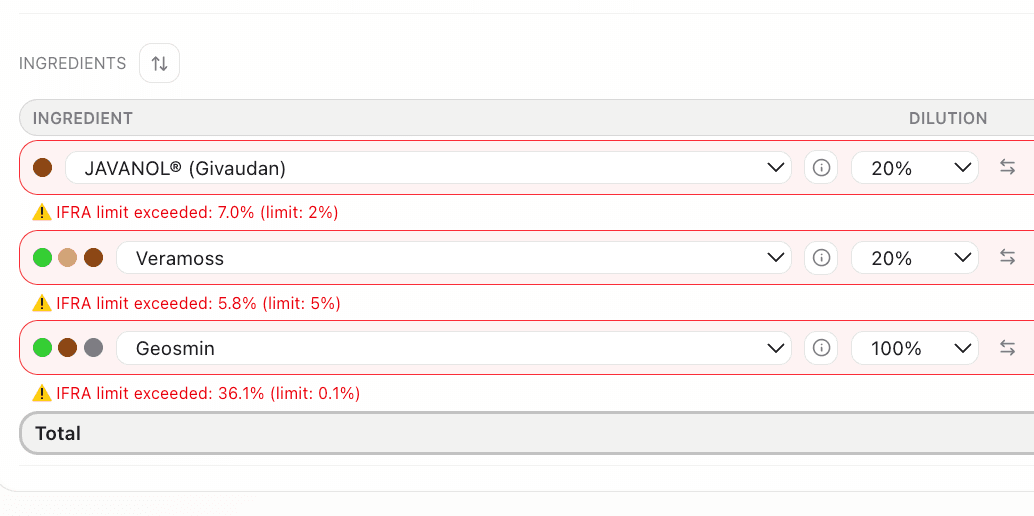
Perfume Workbench includes IFRA limit detection that runs as you build your formula. Add an ingredient, and if its usage exceeds the IFRA limit for your target category, you see a warning immediately—not after you've already mixed the batch.
This gives you the information to make informed decisions. You might:
- Reduce the ingredient to stay within the limit
- Accept the warning for a personal-use perfume
- Look for an alternative ingredient with similar character
- Use an IFRA-compliant version of a restricted natural
Learn as you go
Over time, you'll internalize which ingredients have tight limits. The warnings become less frequent as your instincts develop—but they're always there as a safety net when you try something new.
Staying current with IFRA updates
IFRA Standards aren't static. The organization releases amendments—currently on the 51st Amendment—that can change limits, add new restrictions, or occasionally relax existing ones as new research emerges.
What changes mean for you
- Ingredients you've been using freely might get new restrictions
- Limits might tighten (or occasionally loosen)
- New ingredients might be added to the restricted list
- Some ingredients might be prohibited entirely
For commercial perfumers, staying current is mandatory. For hobbyists, it's good practice—especially if you might eventually sell your work.
Where to find updates
IFRA publishes all amendments and the complete standards library on their website: ifrafragrance.org. Perfume Workbench is regularly updated with the latest IFRA data so your limit checks stay current.
A practical IFRA checklist for hobbyists
Here's how to incorporate IFRA awareness into your practice without letting it paralyze your creativity:
- Know your category — Most hobbyists work in Category 4 (fine fragrance). Know the limits that apply to your work.
- Use tools with built-in checking — Manual checking is tedious and error-prone. Let software do it automatically.
- Pay attention to warnings — Don't ignore limit warnings, even for personal use. Understand why the limit exists.
- Keep compliant formulas separate — If you might sell or gift a perfume, make sure it's within IFRA limits.
- Learn the common restrictions — Know which of your favorite ingredients have tight limits.
- Use IFRA-compliant versions when available — Many restricted naturals have compliant versions (e.g., oakmoss with atranol removed).
- Stay curious, not scared — Restrictions are information about ingredient behavior, not punishment.
The bottom line
IFRA isn't the enemy of hobbyist perfumery. It's a body of knowledge about ingredient safety that you can use to make informed decisions. The restrictions exist because some ingredients can cause real harm at high concentrations—that's information worth having.
For personal use, you can choose how closely to follow the guidelines. For anything you sell or give away, compliance matters—both ethically and legally.
The goal isn't to fear IFRA, but to understand it well enough that compliance becomes second nature—a background check that protects you and others while you focus on creating beautiful scents.
Perfume Workbench includes built-in IFRA limit detection that works as you formulate. See warnings in real time, make informed decisions, and build formulas you're confident sharing. Try it free and let the software handle the compliance tracking while you focus on the art.