How to Scale a Formula from 10g to 100g Without Breaking Ratios
Why scaling a perfume formula often ruins the composition—rounding errors, percent vs gram confusion, and trace materials—and how to scale correctly so ratios stay exact.
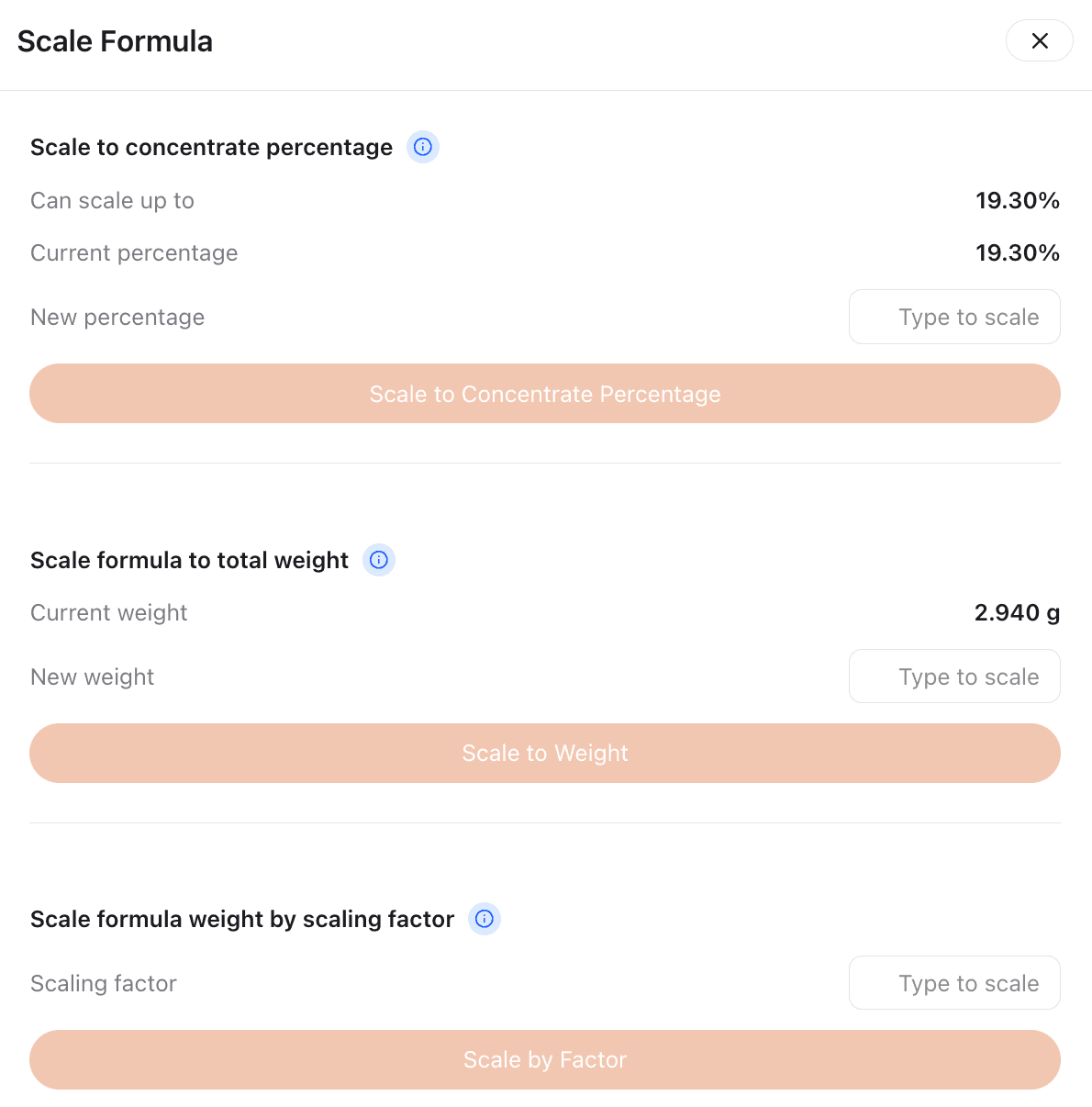
Scaling a perfume formula should be mechanical. In reality, it's one of the easiest ways to accidentally ruin a composition.
You start with a beautiful 10g test batch. You scale it to 100g for production. Suddenly it smells sharper, muddy, or just… off. What happened?
This guide breaks down why scaling goes wrong, how to do it correctly, and how to avoid the classic "why does this smell different now?" moment.
The core problem: scaling drift
In theory, scaling from 10g to 100g is simple: multiply everything by 10. In practice, three things quietly destroy your formula.
1. Rounding errors compound
When you scale manually, 0.17g becomes 1.7g, 0.03g becomes 0.3g. You round "just a little" because your scale only reads to 0.01g. Across 20–50 materials, those tiny changes add up. The total no longer matches your target, and your ratios drift.
2. Percent vs gram confusion
Many formulas are written in % of concentrate, grams of concentrate, or % of finished product. Scaling between them manually invites mistakes: ingredients no longer sum to 100%, fixatives and trace materials shift in dominance, and top notes spike or collapse.
3. Trace materials are the first to break
That 0.05% material? It's suddenly 0.08% instead of 0.10%, or it gets rounded down and nearly disappears. Trace materials define texture, diffusion, and realism. They're fragile—and scaling often breaks them first.
Why a formula can smell different after scaling
Even if everything looks right on paper, small ratio changes can cause overexposed top notes (especially citruses, aldehydes), a muted heart (florals losing balance), a heavier base (musks, ambers creeping up), or loss of transparency and lift.
Perfumery is nonlinear. A 0.1% shift in Iso E Super is not the same as a 0.1% shift in Hedione. That's why scaling must be mathematically exact, not approximate.
The correct way to scale a formula
When scaling from 10g to 100g (or any batch size change), nothing about the internal ratios should change.
What must stay constant: the relative % of each material within the concentrate; the total must still equal exactly 100%; gram weights must update proportionally. What must change: only the concentration multiplier.
If your formula smells different after scaling, something drifted.
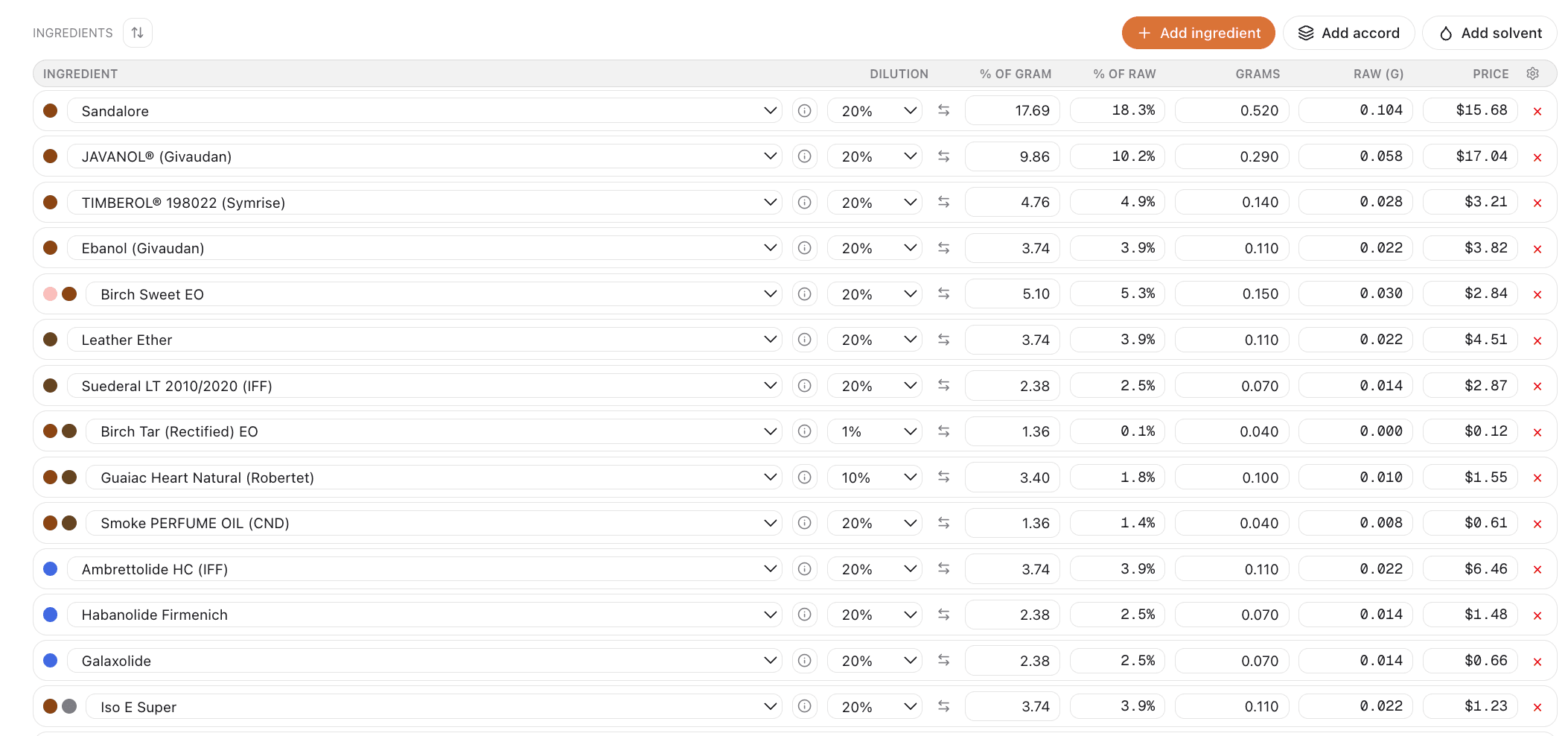
Where manual scaling breaks down
Even experienced perfumers struggle because Excel sheets desync, one cell update breaks another, percentages don't auto-normalize, and you forget which column is "authoritative." Manual tools weren't built for perfumery logic.
How Perfume Workbench solves this
This is exactly the problem Perfume Workbench was built to eliminate.
Always-accurate scaling
- Change batch size from 10g → 100g; every material updates instantly.
- Ratios stay mathematically exact; totals always sum to 100%.
- No rounding drift, no silent errors.
Grams and percentages stay in sync
Edit in grams → percentages update. Edit in percentages → grams update. Finished product, concentrate, or batch size—all consistent.
Safe for trace materials
No accidental flattening, no disappearing nuances. Your micro-dosages stay micro.
Confidence at any scale
Whether you're evaluating 10 g, scaling to 100 g, or preparing 5 kg for production, the formula remains identical in structure—only bigger.
The real goal: trust your formula again
When a scaled version smells different, you don't know: is the idea flawed, or did the math betray you? Correct scaling removes that doubt.
If it smells different after scaling with exact ratios, then it's a real creative signal—not a spreadsheet error. That's the difference between guessing and working professionally.
Final thought
Scaling shouldn't be a creative gamble. It should be boring, precise, and invisible. If you want your formulas to scale cleanly, stay true to the original idea, and survive real production sizes—Perfume Workbench makes sure the math never gets in the way of the scent.