Version Control for Perfume Formulas: The Fastest Way to Iterate Without Losing "The Good One"
Why one small change can ruin a formula—and how save, restore, and compare versions give you a clean iteration workflow so you never lose the version that worked.
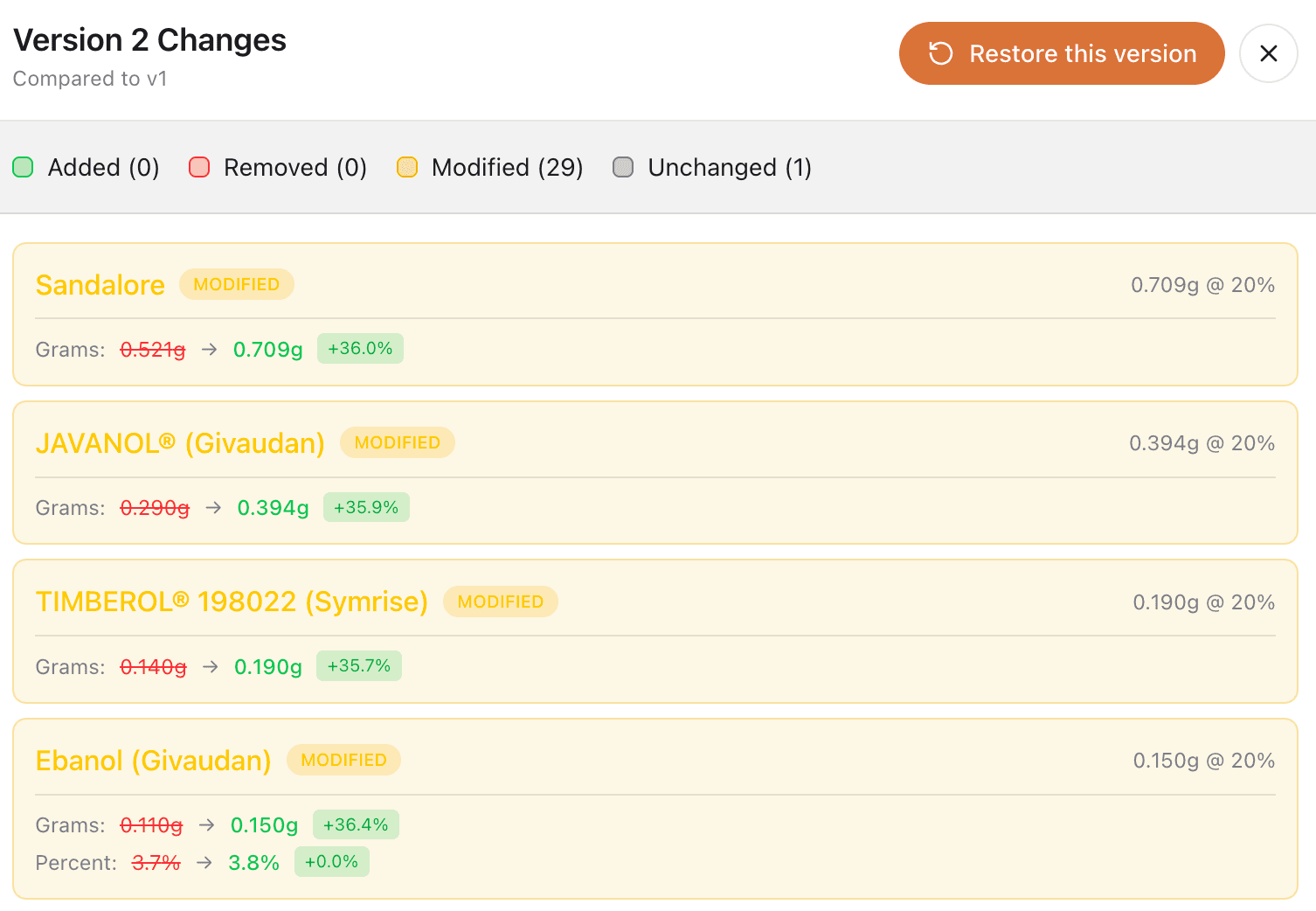
You've been there: the formula was almost right. You tweaked one thing—a bit more hedione, a drop less oakmoss—and suddenly it's off. Sharper, flatter, or just wrong. You want to go back, but you didn't write down the previous version. Or you did, and now you're squinting at two spreadsheets trying to spot the difference.
I changed one thing and ruined it—now I can't go back.
— The pain every perfumer knows
Iteration is how good formulas become great. But without version control, every tweak is a gamble. This guide shows why saving, restoring, and comparing versions is the fastest way to iterate—and how to build a workflow where you never lose "the good one."
Why one change can ruin a formula
Perfume formulas are delicate. A 0.1% shift in a key material can tilt the whole balance—top notes spike, the heart goes flat, or the base takes over. When you're iterating, you're making many small changes. Without a clear record of what you had before, you can't reliably undo or compare.
Manual backups—copying a spreadsheet, scribbling percentages on paper—break down fast. You forget which file was "before the hedione change." You mix up dates. Or you never saved at all, and the good version is gone.
What real version control looks like
Version control for formulas means: save a snapshot whenever you want (e.g. "before trial 3"), restore any snapshot with one click, and compare two versions side by side so you see exactly what changed—ingredients, percentages, grams.
Save
Save a version when you're at a point you might want to return to: before a big change, when something smells right, or at the end of a session. You can name it (e.g. "v2 – more floral") or leave it timestamped. The important part is that the full state—every ingredient and percentage—is stored.
Restore
When a tweak goes wrong, open version history, pick the version you want, and restore. Your formula rolls back to that snapshot. No digging through files or re-entering by hand. You're back to "the good one" in seconds.
Compare
Sometimes you're not sure which version was better—or you want to see what actually changed. Compare two versions side by side: added or removed ingredients, changed percentages, rescaled weights. That clarity makes the next iteration intentional instead of guesswork.
A clean iteration workflow
- Save a version before you try a bold change (e.g., "v1 – baseline" or "pre-hedione bump")
- Make your tweaks and evaluate on blotter or skin
- If it's worse: restore the saved version and try a different direction
- If it's better: save again with a descriptive name (e.g., "v2 – hedione +0.5%, reduced citrus")
- Use compare when you want to see exactly what changed between two saves
Naming tip
Use version names that describe what changed, not just "v2" or "v3." Six months from now, "v3 – more amber, less rose" tells you something; "v3" doesn't.
With that loop, you never lose a good state. You can take risks, revert in one click, and see the diff when it helps. Iteration stays fast and under your control.
How Perfume Workbench handles versions
Perfume Workbench is built for this. Save a version anytime with one click—optionally with a name. Your version history lists all snapshots (newest first), so you can restore any of them instantly. The compare view shows two versions side by side: what was added, removed, or changed in percentage and grams.
Versions are saved automatically when you add or remove ingredients or change scale, and you can create named snapshots whenever you want. So you can iterate freely, revert when a tweak backfires, and never lose the version that worked.
Try it
Use Perfume Workbench's version history on your next formula: save before a risky change, restore if it goes wrong, and use compare to see exactly what changed. It's the fastest way to iterate without losing the good one.